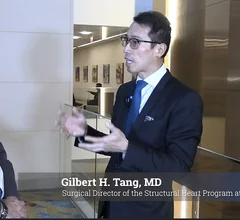
The interventional treatment of tricuspid valve disease has evolved in recent years thanks to new research and critical FDA approvals. Cardiologist Ryan Kaple, MD, reviewed this trend for a new video interview.
This type of tracking helps a practice understand how radiologists interact with AI, whether they're appropriately rejecting incorrect results, and if the technology is improving detection of important findings.
Tim Szczykutowicz, PhD, associate professor radiology, University of Wisconsin Madison, explains the new technology developments in GE HealthCare's FDA 510(k)-pending photon-counting CT scanner.
Intravascular lithotripsy is expected to see even wider adoption when lower-profile catheters are introduced and device costs start to drop, explained Samin Sharma, MD.
Radiology Business Management Association (RBMA) President Christopher Crancer shared some early highlights from the group's 2024 PaRADigm annual meeting in Las Vegas. "We have a very engaged membership," he said.
Gregg Stone, MD, explains the details of the late-breaking RELIEVE-HF trial at ACC.24, where an inter-atrial shunt improved symptoms in HFrEF, but not in HFpEF patients.
Howard C. Herrmann, MD, principal investigator of the SMART trial, discussed his team's research on self-expanding vs. balloon-expandable TAVR valves in patients with small annuli.
Interventional cardiologist Foluso Fakorede, MD, opened a practice in rural Mississippi, the epicenter of the PAD and CLI epidemic, to try and reverse the glaring health disparities in that region.
Rads should learn more about employment negotiations before signing a contract, says Seetharam Chadalavada, MD, vice chair of radiology informatics at the University of Cincinnati.