Home

Cardiology Associations

This page includes news coverage of cardiology societies and associations. Follow these links for specific cardiology society news pages: American College of Cardiology (ACC), American Heart Association (AHA), American Society of Echocardiography (ASE),  American Society Nuclear Cardiology (ASNC), European Society of Cardiology (ESC), Heart Rhythm Society (HRS), Society for Cardiovascular Angiography Interventions (SCAI), Society of Cardiovascular Computed Tomography (SCCT), Transcatheter Cardiovascular Therapeutics (TCT), and Vascular Interventional Advances (VIVA). 

RSS icon

  • Cathie Biga, MSM, MACC, past president of the American College of Cardiology (ACC) and president/CEO of Cardiovascular Management of Illinois, spoke in a business session at ACC 2026 on the use of artificial intelligence analytics and said human interface is needed to make the data actionable.

    The key to AI cardiology analytics is human action

    While AI analytics has greatly increased the ease of access to vast amounts of cardiology data, action is still required to make it useful.
     

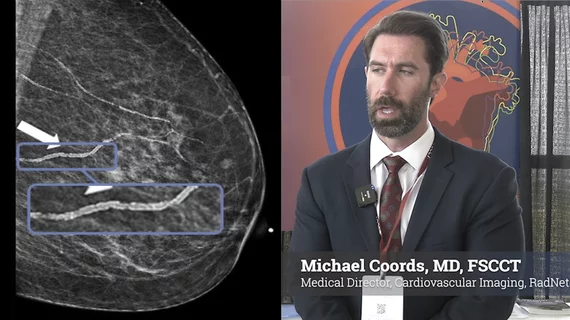
  • Michael Coords, MD, FSCCT, Medical Director of Cardiovascular Imaging, RadNet, a leader with the SCCT Health Policy and Practice Committee Regulatory Task Force, and incoming co-chair of the Health Policy and Practice Committee, says SCCT offers a unique blend of clinical education, business strategy, and networking to stay on top of CCTA's rapid proliferation.

    Radiologists: Take the deep dive into advanced cardiovascular CT at SCCT

    SCCT offers a unique blend of clinical education, business strategy, and networking to stay on top of CCTA's rapid proliferation.

  • Ronen Rubinshtein, MD, FACC, FESC, director, heart institute, Edith Wolfson Medical Center, in Holon, Israel, president elect for the Society of Cardiovascular Computed Tomography (SCCT), and chairman of the SCCT 2026 annual scientific meeting, explains plaque imaging, AI and structural heart disease are the spotlight at the meeting.

    Plaque imaging, AI and structural heart disease in the spotlight at SCCT 2026 meeting

    Coronary plaque imaging is an area many experts believe is driving a shift toward earlier detection and prevention of heart disease.

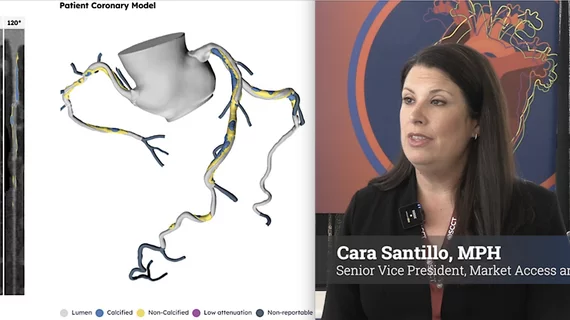
  • A figure from the new SCCT FFR-CT consensus document to help explain how the technology works to assess hemodynamic flow using CT imaging.

    CT-FFR standardized in new SCCT-SCAI consensus statement

    FFR-CT literature has reached a state of maturity where experts can comfortably start to provide guidelines to the wider community. 

  • Robert Hawkins, MD, MSC, assistant professor of cardiac surgery, University of Michigan, discusses the growing trends of surgical aortic valve replacement (SAVR) following prior transcatheter aortic valve replacement (TAVR) and how to best risk assess these patients using a new STS risk calculator.

    How to evaluate risk when TAVR patients require surgery later in life

    Robert Hawkins, MD, discussed an updated risk calculator—and the latest data on SAVR after TAVR—for a new video interview with Cardiovascular Business.

Angiography demonstrates a high-grade, modestly angulated stenosis (arrow) in the proximal segment of a large diagonal branch (A). Predilation performed with difficulty, and the GEC could not be advanced beyond stenosis even with “inch worming” techniques. (B). Advancement of the CrossFAST (C) beyond the proximal stent edge stenosis (a.), the position of the distal end of the outer catheter (b.), and the microcatheter tip (c.) are indicated.

Next-generation guide extension catheter delivers value during complex PCI

The CrossFAST system was successfully used to deploy multiple stents after other devices fell short. 

Semaglutide, the GLP-1 receptor agonist sold by Novo Nordisk under the brand names Wegovy and Ozempic, is associated with significant health benefits for patients with type 2 diabetes and peripheral artery disease (PAD), according to a late-breaking clinical trial presented at ACC.25, the annual meeting of the American College of Cardiology (ACC).

American College of Cardiology announces late-breaking clinical trials for ACC.26

The American College of Cardiology's 2026 annual meeting will include an all-time record of 60 late-breaking clinical studies.

robot reviewing heart data

Cardiologists develop new AI screening tool for structural heart disease

Researchers have developed an advanced AI model capable of detecting signs of severe AS, mitral regurgitation and other complications in ECG results. For example, one 84-year-old patient who was hospitalized for a fractured femur ended up being scanned and treated with TAVR just days later.

Thumbnail

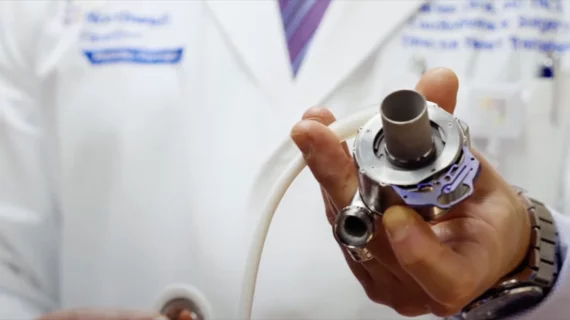
World’s first polymeric TAVR valve impresses cardiologists—could improve durability, reduce costs

The new-look TAVR system was linked to multiple benefits after one year. The cardiologists evaluating this device belief it could significantly reduce the risk of long-term valve degeneration.

The Relief System from Relief Cardiovascular Inc. is a first of its kind device. It incorporates a valve and sensor implant that uses AI to intelligently modulate venous pressure using hemodynamic data. The system actively adjusts flow in the inferior vena cava (IVC), which lowers venous pressure to drive durable decongestion in heart failure.

New AI-enabled heart failure implant shows early potential

The AI-powered Relief System is able to modulate venous pressure using hemodynamic data. The goal is to help patients better manage heart failure congestion at home. 

Thumbnail

Heart failure biomarker identifies long-term risk in T-TEER patients

NT-proBNP measurements are often used to diagnose and manage heart failure. According to a new study of more than 2,000 patients, they can also provide value to cardiologists performing T-TEER.

artificial intelligence AI policy washington capitol

Cardiology groups to Trump administration: AI still has a long way to go

Multiple cardiology societies responded to an HHS request for public feedback by outlining some of the current barriers to wider AI adoption. "It is essential that any policy frameworks must reaffirm that clinicians—not algorithms—remain at the center of patient care," ACC President Christopher Kramer, MD, said. 

After traversing the aortic cusp with an electrified wire and balloon inflation, a stent is positioned inside the noncoronary cusp and deployed. Immediately after, a transcatheter aortic valve is expanded, and the stent is crushed on the left ventricular outflow tract wall and annulus, while anchored to the aortic valve leaflet.

Cardiologists perform first TAVR of its kind by anchoring valve to crushed stent

The patient, 78, presented with severe AR and no signs of calcification. She was considered a poor choice for surgery or traditional TAVR due to multiple risks. That is where the new-look ATLAS technique came in.

Pagination

    • First page « First
    • Previous page ‹ Previous
    • Page …8
    • Page 9
    • Page 10
    • Page 11
    • Current page 12
    • Page 13
    • Page 14
    • Page 15
    • Page 16 …
    • Next page Next ›
    • Last page Last »
Displaying 89 - 96 of 1542
  • Home
  • News
  • Article Archive
  • Custom Content
  • Webinars
  • Press Releases
  • Content Studio
  • Advertising
  • Submit Press Release
  • Contact Us
  • Terms of Use
  • Privacy Policy
  • Cardiovascular Business
  • HealthExec
  • Radiology Business
 
© 2026 Innovate Healthcare | All Rights Reserved. | Terms of Use | Privacy Policy
 
Design by Adaptive Theme