New ASE guideline outlines training standards for interventional echocardiography

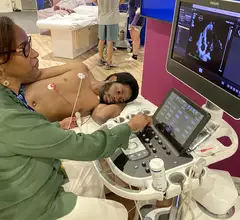
The American Society of Echocardiography (ASE) released a new guideline document that outlines uniform training standards for interventional sonographers guiding structural heart procedures.

Raj Makkar, MD, Cedars-Sinai’s vice president of Cardiovascular Innovation and Intervention and the Stephen R. Corday, MD, Chair in Interventional Cardiology, explains the ACC 2023 results on the safety and efficacy of transcatheter edge-to-edge mitral valve repair in degenerative mitral regurgitation (MR) study. It was a review of data is from the STS/ACC TVT Registry that was presented at the American College of Cardiology (ACC) 2023 meeting.

New data on real-world TEER outcomes in patients with degenerative MR

TEER can significantly improve a patient's chances of survival, new findings confirm.

Thumbnail

Cardiologists, cardiac surgeons support new bill that could limit Medicare cuts

More than 100 U.S. medical societies—including the ACC, ASNC and others—have united in support of a new bill that would make a long-term impact on Medicare payments.

Thumbnail

American College of Cardiology shares new HFpEF recommendations as cases continue to rise

HFpEF now accounts for a majority of heart failure cases, highlighting the importance of ensuring both primary care providers and dedicated heart teams know as much about this topic as possible. 

COVID-19 linked to elevated risk of life-threatening arrhythmia

Patients with severe COVID-19 cases that required ventilation were 16 times more likely to develop ventricular tachycardia within six months, researchers found. 

The Medtronic CoreValve Evolute on display at ACC 2022. The valve performed better than surgical valved in terms on structural deterioration. #ACC22

Redo TAVR appears feasible for most patients with supra-annular, self-expanding Evolut valves

Researchers evaluated data from more than 200 patients who underwent redo TAVR, noting that women and patients with a higher BMI faced a higher risk of coronary flow compromise.

New details on the link between CVD and cancer, from a study of 27M patients

According to the large new study, published in JACC: CardioOncology, atherosclerotic CVD is associated with an especially high risk of cancer. 

Marielle Scherrer Crosbie and Tomas Neilan explain the STOP-CA trial and how statins can help prevent cardiotoxicity from anthracycline chemo agents.

Statins may help prevent anthracycline cardiotoxicity in chemotherapy

The STOP-CA trial showed that statins can help chemotherapy patients avoid potential side effects related to anthracycline agents. Co-principal investigators Marielle Scherrer-Crosbie, MD, and Tomas Neilan, MD, discussed the details of that trial at ACC.23.