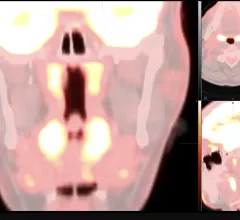
Positron emission tomography/computed tomography is a hybrid nuclear medicine imaging technique that helps radiologists spot abnormal metabolic activity. PET/CT is commonly used to diagnose cancers, heart diseases and certain brain disorders, among other conditions.

Though both modalities offer providers insight into the extent of a patient’s disease, WB-MRI may be more beneficial for patients than the current standard of care.
Though these treatments are typically done with assistance from real-time fluoroscopy, there is ample evidence nuclear imaging may offer more benefits.
Currently, the organization relies on a mobile PET unit that parks once every week. However, demand has grown for PET/CT in the area, rising by around 60% over the last three years alone.
A comparison of the detection rates for 68Ga-PSMA PET/CT and mpMRI in low, intermediate and high-risk prostate cancer was recently shared by experts in EJNMMI.
Such scans determined the final diagnosis in 54% of patients and were more accurate than CRP and WBC levels for identifying fever origin, according to research published in Scientific Reports.
"The accuracy of PSMA-PET is essential to improve stratification and potentially outcomes both in low-risk and high-risk settings,” a doctor involved in the study explained in the Journal of Nuclear Medicine.
“We showed that risk prediction does not depend on cardiovascular risk scores, stenosis severity or CT calcium scoring," researchers said in the Journal of Nuclear Medicine.