Magnetic Resonance Imaging

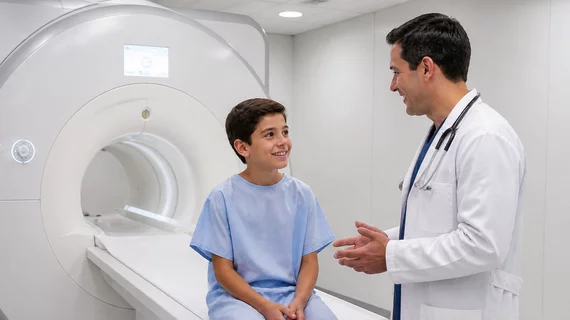
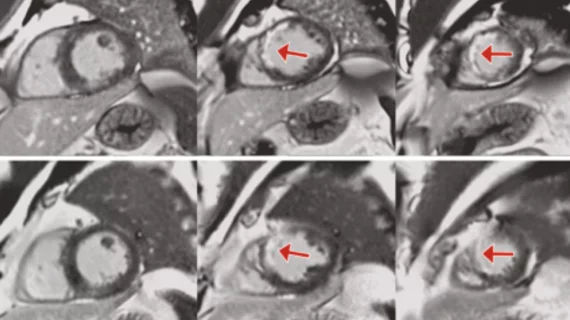
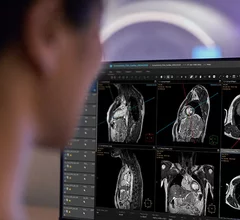
Cardiac magnetic resonance imaging MRI is used as both a functional and anatomical cardiac imaging test. It offers excellent soft tissue detail and the ability to quantify cardiac function. MRI scans can be performed with or without gadolinium contrast depending on what information is needed. Unlike computed tomography (CT), MRI does not use X-ray radiation, but patients with metal implants may have contraindications for MRI use because MR will heat up most metal objects. MRI exams usually take much longer than CT scans. How does MRI work? MR creates images by using powerful magnets to polarize hydrogen atoms in water (the body is made of of more than 80% water) so they face in one direction. A radiofrequency pulse is then used to ping these atoms, causing them to wobble, or resonate. The MRI coils detect this and computers can assemble images from the signals. Basic MRI scans will focus on the resonance of fat and water in two different sequences, which highlight and contrast different features in the anatomy.


Oktoberfest beer pretzel germany munich

‘Beer belly’ associated with multiple heart risks, especially in men

Abdominal obesity, the phenomenon commonly known as “beer belly," may be associated with significant risks, including heart failure. Researchers urged cardiologists and radiologists alike to keep these findings in mind going forward.

White House releases statement on Trump’s heart health, MRI results

The update follows weeks of uncertainty and speculation after the president revealed he had undergone an MRI.

Right ventricle MRI marker independently predicts heart failure

Single MRI finding independently predicts heart failure

Experts recently have become more interested in measurements of strain as predictive markers of adverse cardiac outcomes in the general population and across several pathologies.

Cardiologist seeks answers about Trump’s health after MRI

After President Donald Trump told reporters he underwent an MRI—adding that the results were “perfect”—it remains unclear why, exactly, the scan was ordered in the first place.

Researchers using 4D MRI technology to test artificial hearts.

4D MRI techniques could help advance the development of artificial hearts

Researchers recently used advanced 4D flow MRI to track blood in a pulsating artificial heart, revealing dynamics that closely mirror those of a healthy human organ.

artificial intelligence heart AI

FDA clears AI-powered cardiac imaging platform

The Tempus Pixel platform was designed to assist clinicians with the evaluation of cardiac MR images.

pericarditis cardiac imaging

Pericarditis: New guidance takes on the diagnosis and management of a challenging heart condition

Pericarditis, inflammation of the pericardium, accounts for approximately 5% of all emergency department evaluations for chest pain. These new recommendations are designed to help guide clinicians through the ins and outs of patient care. 

An example of artificial intelligence automated coronary artery calcium scoring shown by Coreline at ACC23. The AI also identifies and color codes the anatomy so help show the reviewing radiologist or cardiac imager what and where things were calculated. #ACC #ACC23

Cardiology still No. 2 in FDA-cleared clinical AI algorithms, trailing only radiology

Cardiology continues to be one of the most influential healthcare specialties when it comes to utilizing artificial intelligence.