The last few months in mergers and acquisition (M&A) activity in healthcare have been dominated by massive deals proposed across sectors—like drugstore chain CVS Health wanting to buy health insurer Aetna for $69 billion. What those companies should watch for, writes Morning Consult’s Jon Reid, is the result of the case challenging a merger with similar dynamics: the combination of AT&T and Time Warner.
Just because you can doesn't mean you should, an NBC News editorialist said regarding the FDA's latest approval of an at-home cancer screening kit requiring zero assistance from a doctor.
Many people don’t know they have cardiovascular disease until they end up in the hospital with myocardial infarction. But a few strange external signs could signal all is not right with the heart, an anatomy professor noted in The New Zealand Times.
For-profit hospital giant HCA has entered into discussions to acquire Mission Health, a nonprofit six-hospital system based out of Asheville, North Carolina, in a deal Mission admitted may result in some jobs being eliminated.
A novel machine learning model could accurately predict which men might benefit most from additional imaging before a prostate biopsy, saving patients both money and discomfort, a new study states.
A long-standing agreement between three rural Montana hospitals—Monida Shared Imaging—recently added a second mobile MRI unit to bring state-of-the-art equipment to areas that would have been without, Kpax.com reports.
To engage millennial radiology trainees, educators need to pay special attention to their unique learning patterns, according to a new study published in Academic Radiology.
Photo courtesy of the University of Southern California (USC).
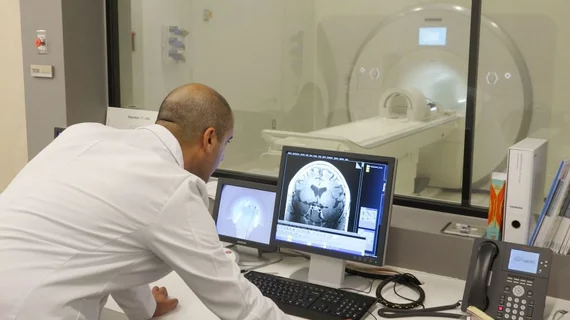
A noninvasive 7 Tesla MRI scanner at University of Southern California is the first 7T scanner to be used on a patient with Cushing's disease in the U.S., according to a USC news release.
Medicare was the primary payer for 90 percent of transcatheter aortic valve replacement (TAVR) hospitalizations over a recent three-year period, according to a March 19 report in JACC: Cardiovascular Interventions. With that in mind, the recent proposal to cut $473 billion from the CMS budget over the next decade could limit access to the increasingly popular procedure, researchers noted.
CMS Administrator Seema Verma, MPH, offered some hints at the agency’s priorities in its annual rulemaking for Medicare this year, suggesting a slew of new policies on price transparency, interoperability and physician self-referral laws.