The rapid advancement of AI technologies has left the medical community in a state of flux, unsure of where to direct their efforts to deliver the best, most effective care. But to one dean the answer is simple: prioritize patients.
Data alone can’t bring in new partnerships and build a successful healthcare operator. There has to be a story behind the data to help get new models of care off the ground, according to partners with PwC, who spoke at ACHE's Congress on Healthcare Leadership conference in Chicago.
Tracking patients’ changes in fractional flow reserve (FFR) from before to after a percutaneous coronary intervention (PCI) may provide useful information, according to new research published in JAMA Cardiology. Individuals with the greatest change in FFR were less likely to experience vessel-related events and demonstrated greater symptomatic relief.
More than seven months after the U.S. House of Representatives voted to permanently repeal the country’s medical device tax, bipartisan legislation to accomplish the same goal has been introduced in the U.S. Senate
CHICAGO, March 7, 2019 — Northwestern Medicine Bluhm Cardiovascular Institute is pioneering the use of artificial intelligence (AI) for cardiac screening in a new study of Eko’s cardiac monitoring platform. The study aims to demonstrate that Eko’s digital stethoscopes and AI algorithms can interpret heart sounds accurately to help screen for pathologic heart murmurs and valvular heart disease.
U.S. Senators Pat Toomey, R-Pennsylvania and Amy Klobuchar D-Minnesota introduced bipartisan legislation, Thursday, March 7, to permanently repeal the 2.3 percent medical device tax.
The courts typically side with defendant physicians when patients file medical malpractice lawsuits related to image-guided interventions, according to a new study published by the Journal of Vascular and Interventional Radiology.
Documenting contrast allergies in the electronic health record (EHR) is central for safe imaging, but a new study found such records are incomplete, misleading and often ambiguous. A multidisciplinary approach may be needed to solve the problem.
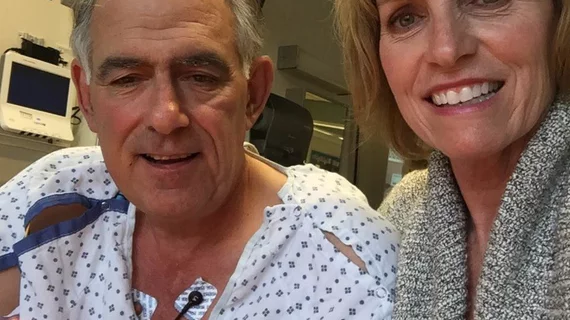
Tom Giangiulio Jr. and his wife, Carin, celebrate his 58th birthday on June 6, 2017, two weeks before Giangiulio received a transplant with a Hepatitis C-infected heart.
By the time three transplant physicians approached Tom Giangiulio Jr. about being the first patient in a new clinical trial to accept a heart from a Hepatitis C-positive donor, Giangiulio didn’t have much of a choice.