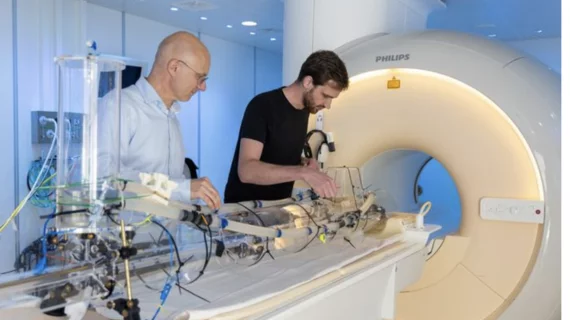
Researchers an Linköping University preparing to test an artificial heart using 4D MRI. Photo courtesy of Emma Busk Winquist.
Researchers recently used advanced 4D flow MRI to track blood in a pulsating artificial heart, revealing dynamics that closely mirror those of a healthy human organ.
TAVR reintervention rates remain low. However, they are slowly rising as the procedure is used more to treat patients with severe aortic stenosis. Researchers think this trend may continue going forward.
“It’s been a whirlwind,” Anders Gilberg, senior vice president of government affairs at MGMA, told HealthExec. “Rarely do we have an administration come in and do so much in such a short period of time.”
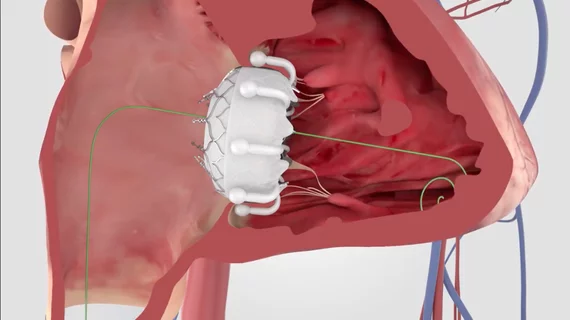
The Evoque TTVR system. Image courtesy of Edwards Lifesciences.
There have been so many developments in the treatment of TR that it can be challenging to keep up. The ACC crafted this new document to help ensure cardiologists, cardiac imagers and other clinicians have access to the most recent clinical data and policy decisions.
Researchers believe that it could be especially beneficial in patients with impaired kidney function who may be at risk of adverse reactions to standard ICM.
The Society of Interventional Radiology on Monday formally announced its opposition to the Wasteful and Inappropriate Service Reduction (or “WISeR”) Model.
"Manufacturers of radiology devices may be less likely to disclose payments because many fall outside current reporting requirements," researchers write in JAMA.