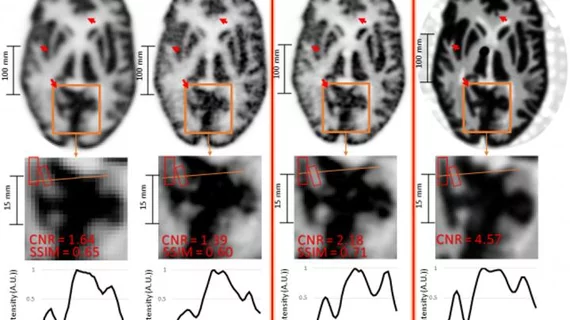
Top row: same PET slice reconstructed with A) 2mm static OSEM, B) 1mm static OSEM, C) proposed SR method and D) corresponding CT slice (note that the CT image can be treated as a high-resolution reference). Middle row: zoom on region of interest for corresponding images. Bottom row: Line profiles for corresponding data. Photo: Y Chemli, et al., Gordon Center for Medical Imaging: Department of Radiology Massachusetts General Hospital, Harvard Medical School, Boston, MA.