Follow-up care after a successful heart transplant can be challenging—both for providers and their patients. Consider, for example, the fact that so many patients who develop complications never actually present with symptoms.
The use of AI technologies in healthcare has evolved at a breathtaking rate in the last few years. Hype and hypotheticals have been replaced with real, practical tools that help physicians focus on providing high-quality care.
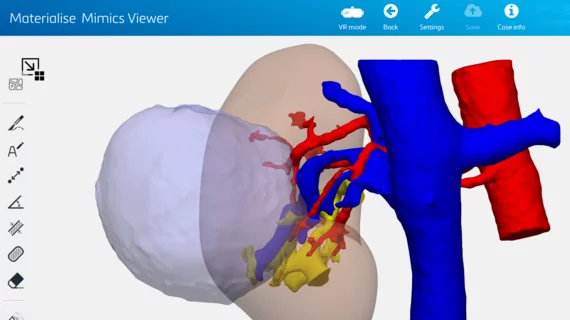
3D surface modeling and virtual surgical planning are expanding radiology’s contribution to multidisciplinary teams. Together, AI-driven interpretation and 3D-enabled clinical collaboration represent two distinct, complementary forces shaping the next decade of radiology.
As radiology departments across the US continue to navigate the complexities of the current imaging market, including disruptions in supply chains and increased demand for CT contrast media, one constant remains: the need for reliable, quality supply partners to help sustain patient care.
DocMoonlight, the nation’s largest provider of onsite contrast supervision, and ContrastConnect, the largest provider of virtual contrast supervision, today announced a strategic collaboration designed to offer imaging organizations the most complete, flexible, and scalable contrast supervision solution in the industry. By aligning their complementary strengths, the partnership is aimed at expanding patient access, enhancing patient safety, and meeting growing imaging demands across diverse regulatory environments.
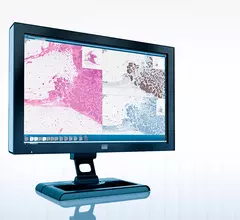
When it comes to diagnosing cancer, radiologists examine digital images and pathologists scrutinize slides. Only occasionally do the two collaborate prior to meetings of the tumor board or multidisciplinary team (MDT).
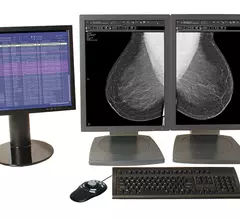
When working at a high volume breast imaging provider, radiologists can’t afford speed bumps. But hiccups in workflow are inevitable when a radiologist is forced to constantly switch between different workstations, each with their own interfaces and controls.
Apple used to push the world to “think different.” Today, the profession of radiology is being driven to think differentiation. And the impetus is issuing not from a single corporation, but rather from myriad market forces—from commoditization to consolidation to, perhaps most pressingly, ever-narrowing profit margins.
Through the exceptionally tight partnership of vRad Chief Medical Officer, Ben Strong, MD, and Chief Information Officer, Shannon Werb—explored in Part I of this interview—vRad has achieved a synergistic melding of those concepts that truly are driving clinical innovation, as evidenced by the discussion with Strong and Werb.
Earlier this year vRad and San Diego-based XIFIN (pronounced zy-fin) began closely collaborating on an online workflow that will offer referring physicians a one-stop fusion of all diagnostic reports—from radiology, pathology and clinical labs.
As an early adopter of speech recognition technology in 2000, Richard H. Wiggins, III, MD, CIIP, FSIIM, witnessed a stunning reduction in turnaround times (TAT) at the University of Utah Health Care, Salt Lake City.
Breast-imaging interpretations by telemedicine? More than a few have said that it couldn’t be done—or, at least, that it couldn’t be done well.