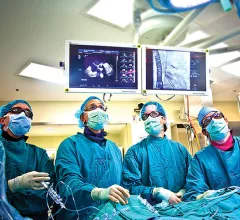
Structural Heart Disease

Structural heart diseases include any issues preventing normal cardiovascular function due to damage or alteration to the anatomical components of the heart. This is caused by aging, advanced atherosclerosis, calcification, tissue degeneration, congenital heart defects and heart failure. The most commonly treated areas are the heart valves, in particular the mitral and aortic valves. These can be replaced through open heart surgery or using cath lab-based transcatheter valves or repairs to eliminate regurgitation due to faulty valve leaflets. This includes transcatheter aortic valve replacement (TAVR). Other common procedures include left atrial appendage (LAA) occlusion and closing congenital holes in the heart, such as PFO and ASD. A growing area includes transcatheter mitral repair or replacement and transcatheter tricuspid valve repair and replacement.

Transaxillary TAVR emerges as top alternative to femoral access

Transsubclavian or transaxillary (TAx) access has become the preferred route for balloon-expandable TAVR when femoral access isn’t feasible, a new analysis found. Outcomes were generally favorable with TAx TAVR compared to other alternative access techniques, with the exception of higher stroke rates, researchers reported in JACC: Cardiovascular Interventions.

Thumbnail

Registry analysis finds link between TAVR volume, mortality

With CMS just months away from an updated national coverage determination for transcatheter aortic valve replacement (TAVR), a new analysis in the New England Journal of Medicine suggests the relationship between procedural volume and TAVR outcomes remains important in the United States.

Thumbnail

Babies more likely to have congenital heart defects when fathers smoke

When pregnant women inhale secondhand smoke—including from prospective fathers—it may be even more dangerous to their offspring than if the women smoke themselves, according to a meta-analysis published in the European Journal of Preventive Cardiology.

Thumbnail

SCAI publishes consensus document on PFO closure

An expert consensus statement published by the Society for Cardiovascular Angiography and Interventions (SCAI) offers guidance for the safe and effective use of patent foramen ovale (PFO) closure devices to prevent recurrent stroke.

Thumbnail

Early AVR bests ‘watchful waiting’ in asymptomatic patients

Patients with severe but asymptomatic aortic stenosis have better survival two and three years later if an aortic valve replacement (AVR) is initially recommended instead of a “watchful waiting” approach, according to a single-center study published in The Annals of Thoracic Surgery.

COAPT substudy: MitraClip gives lasting boost to quality of life

NEW ORLEANS — Patients who received the MitraClip device to treat heart failure with secondary mitral regurgitation showed significant and lasting improvements on a quality-of-life assessment compared to people treated with optimal medical therapy alone, according to a substudy of the COAPT trial presented at the American College of Cardiology’s scientific sessions.

Thumbnail

‘Really not close’: TAVR trumps SAVR in two trials of low-risk patients

NEW ORLEANS — Two trials evaluating transcatheter aortic valve replacement (TAVR) in low-risk patients haven’t just shifted the TAVR versus surgical AVR discussion. They’ve completely flipped it, said experts here at the American College of Cardiology’s scientific sessions.

Thumbnail

Should cardiologists operate sooner for chronic aortic regurgitation?

Patients who received aortic valve repair or replacement (AVR) based on Class II indications fared better than those who underwent surgery for Class I triggers in a single-center study, suggesting earlier intervention may be warranted in asymptomatic individuals with chronic aortic regurgitation.