Experts use MRI to identify brain pathways responsible for epileptic seizures

brain connections that cause epileptic seizures

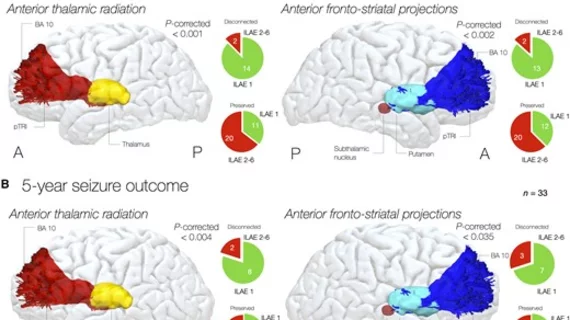
 (A) After 3 years, disconnection of anterior thalamic and striatal projections was associated with seizure freedom. Pie charts show patients being seizure free (green, ILAE 1) or seizure-relapsing (red, ILAE 2–6) according to each tract being disconnected or preserved. Each tract group includes the same tract in the left and right hemisphere. (B) Also, after 5 years, disconnection of anterior thalamic and striatal projections was associated with seizure freedom. Pie charts show patients being seizure free (green, ILAE 1) or seizure-relapsing (red, ILAE 2–6) according to each tract being disconnected or preserved.

Courtesy of Brain.

Patients who have these pathways disconnected record marked seizure-free periods of time in the long-term, according to new research.

New technique improves accuracy of near-infrared fluorescence imaging

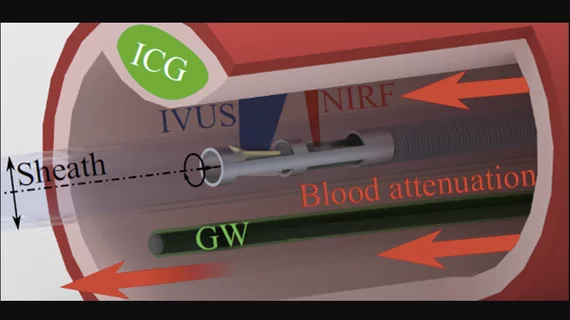
The variable fluorescence attenuation of blood has been a hindrance to near-infrared fluorescence (NIRF) measurements in cardiovascular imaging. Fortunately, researchers have devised an innovative correction method in which the guidewire (GW) is coated with the fluorescent agent (ICG) and used as a reference standard in each frame, leading to a much higher accuracy. Credit: Rauschendorfer et al., doi 10.1117/1.JBO.28.4.046001

The variable fluorescence attenuation of blood has been a hindrance for accurate measurements in the new intravascular imaging modality in development. Fortunately, researchers have devised an innovative correction method in which the guidewire is coated with a fluorescent agent and used as a reference standard in each frame, leading to a much higher accuracy. Credit: Rauschendorfer et al., doi 10.1117/1.JBO.28.4.046001

NIRF imaging could help interventional cardiologists personalize care in the cath lab, but a key engineering issue needed to be solved first.