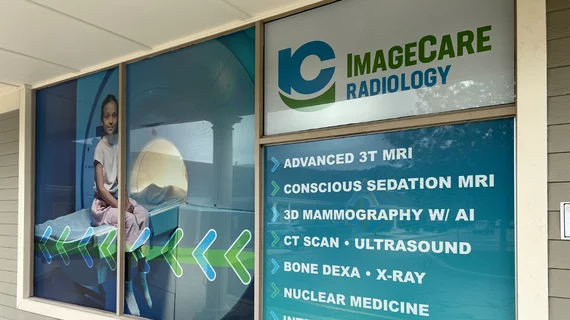
ImageCare Radiology announced the decision Nov. 21, with the practice pulling out of Atlantic Health's Hackettstown and Newton Medical Centers effective the same day.
We set out to find radiology and imaging up-and-comers under 40 who stand out, landing on a laudable list of radiologists, interventionalists, business leaders, researchers, entrepreneurs, educators, AI developers, technologists and mentors.
It’s been years since AI proponents started promising big returns on healthcare providers’ investments in the technology. The results have yet to catch up with the pitches. What’s the holdup?
Texas Attorney General Ken Paxton claims Memorial Hermann Health System violated a state law that authorizes any establishment serving the public to allow police officers to carry firearms, even if they’re dressed in civilian clothing.
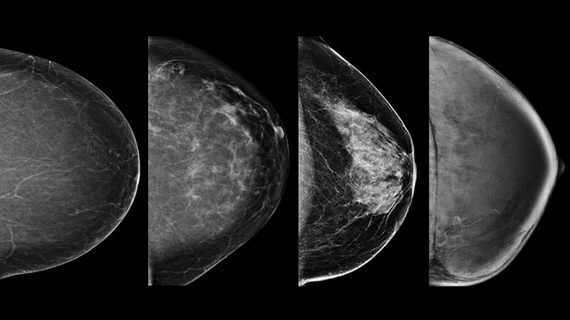
Example of the four types of breast tissue density. The density of fibroglandular tissue inside the breast impacts the ability to easily see cancers. On X-ray mammography, cancer and dense breast tissue both appear as white and can hide smaller cancers on 2D mammography. Dense breasts are also a risk factor for cancer. Cancers are very easy to spot in fatty breasts, but are almost impossible to find in extremely dense breasts. These examples show craniocaudal mammogram findings characterized as almost entirely fatty (far left), scattered areas of fibroglandular density (second from left), heterogeneously dense (second from right), and extremely dense (far right). Read more. Image courtesy of RSNA
Breast density is most often discussed within the context of cancer risk, but new research suggests that it also could be used as a marker of cardiometabolic health.
William W. O'Neill, MD (top left), and Cindy L. Grines, MD (bottom), speak with Timothy D. Henry, MD (top right), about the development of primary PCI. The discussion was part of SCAI's “Pioneers of Interventional Cardiology” series. Image courtesy of SCAI.
SCAI celebrated cardiologists William W. O'Neill, MD, and Cindy L. Grines, MD, for the important roles they played in the development of primary PCI. “It was challenging,” Grines explained. “We had the pharmaceutical industry that was anti-primary angioplasty and we had a lot of our own colleagues that were anti-primary angioplasty."
Caremark, Express Scripts and Optum Rx claim the FTC’s internal administrative court is unconstitutional. The agency sued the PBMs in September, claiming they engage in collusive business practices.