Choosing left radial access in the cath lab helps cardiologists limit radiation exposure

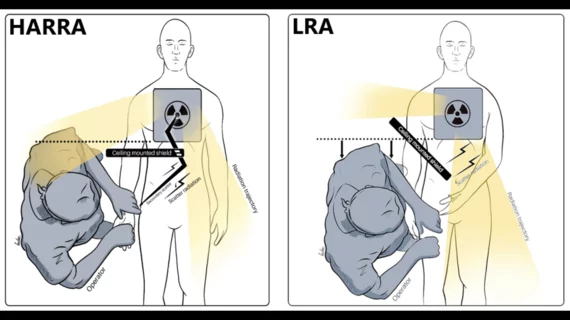
Using a left radial artery (LRA) vs. hyper-adducted right radial artery (HARRA) approach in the cath lab.

Using a left radial artery (LRA) vs. hyper-adducted right radial artery (HARRA) approach in the cath lab can help reduce the amount of radiation dose to operators. Image courtesy of Casazza et al. and Circulation: Cardiovascular Interventions.

Using a left radial artery approach in the cath lab exposes interventional cardiologists to significantly less radiation than a hyper-adducted right radial artery approach. The difference is substantial enough for researchers to declare LRA "the primary access site for cardiac catheterization."

AI quantifies breast arterial calcifications on mammograms

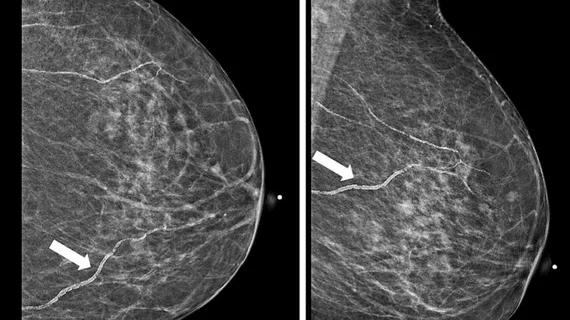
Breast arterial calcifications (BACs) identified on screening mammograms may help identify women who face a heightened risk of developing cardiovascular disease (CVD), according to a new analysis published in Clinical Imaging.

Arrows illustrate breast arterial calcifications for a 65-year-old woman on a screening mammography image (mediolateral oblique and craniocaudal views). Images and caption courtesy of Clinical Imaging

There are no standards requiring radiologists to report on the presence of BACs, even though up to half of referring providers have indicated they would prefer to be made aware of the finding. 

The evolution of RF technology to reduce complications and improve outcomes

Cardiologist Heart Doctor Tablet Technology

Advancements in radiofrequency (RF) catheter ablation technology have been incremental over the past 30 years in efforts to improve safety, procedural efficiency and patient outcomes. While some newer technologies have gained a lot of attention in electrophysiology (EP) over the past several years, RF remains the solid frontline treatment.

Opportunistic screening: AI highlights key heart findings in mammography images

Breast arterial calcifications (BACs) identified on screening mammograms may help identify women who face a heightened risk of developing cardiovascular disease (CVD), according to a new analysis published in Clinical Imaging.

Arrows illustrate breast arterial calcifications for a 65-year-old woman on a screening mammography image (mediolateral oblique and craniocaudal views). Images and caption courtesy of Clinical Imaging

Breast artery calcifications are already visible when radiologists review mammograms, but nothing typically happens with them. Researchers aimed to see if AI could help translate those findings into an easy-to-understand cardiovascular risk score.