Imaging agent catches acute venous thromboembolism missed by other methods

jnm_feb2019_kim_fig2.jpg

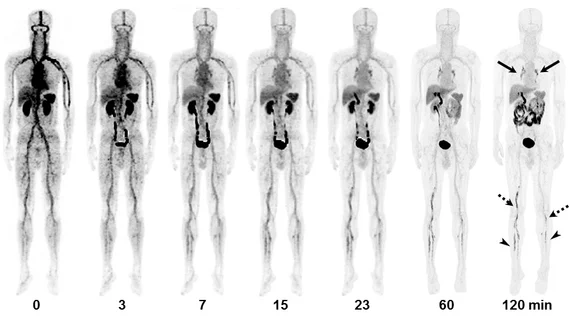
Anterior maximum-intensity projections of 18F-GP1 PET/CT over 120 min show positive 18F-GP1 accumulation in pulmonary arteries (arrows) and in proximal (dotted arrows) and distal (arrowheads) veins of leg, which are gradually distinct on late images as 18F-GP1 activity from other organs is excreted via both urinary and hepatobiliary tracts. Courtesy of Dae Hyuk Moon, MD, et al. 

When diagnosing acute venous thromboembolism (VTE)—a disease that includes deep-vein thrombosis of the leg or pelvis and its complication, pulmonary embolism—PET/CT imaging with a 18F-GP1 radiotracer performed with a higher detection rate than conventional imaging, according to research published in The Journal of Nuclear Medicine.