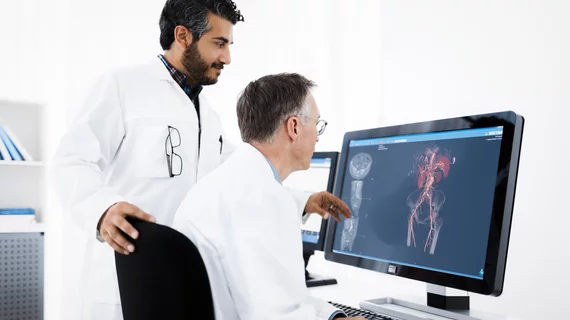
Radiologists 31-40 years into their careers remain incredibly important to patient care in the United States, according to a new study published in Academic Radiology.
Researchers have combined a new imaging technique and imaging agent which utilizes a synthesized amino acid found in scorpion venom to help illuminate brain tumors during surgery.
Private health insurance plans, which cover the majority of people in the U.S., paid higher rates to hospitals compared to public plans such as Medicare and Medicaid, according to a recent report from RAND.
“The results of this research are extremely exciting, as it will significantly impact clinical care,” reported study author Mishal Mendiratta-Lala, MD, with the division of abdominal radiology at Michigan Medicine in Ann Arbor.
A team funded by the National Institutes of Health has succeeded in growing human acellular vessels—implantable, bioengineered human blood vessels—to replace damaged vasculature in patients with end-stage kidney failure.
The American College of Radiology (ACR) announced that 10 radiology residents and fellows have been awarded scholarships to attend the 2019 Radiology Leadership Institute (RLI) Leadership Summit in Wellesley, Massachusetts.
South Korean researchers are working on packing the ability to monitor heart health and detect signs of atrial fibrillation into what might be the smallest cardiology wearable to date: a “smart ring.”
Whole-body MRI (WB-MRI) shows promise as an alternative to multi-modality staging of colorectal cancer and non-small-cell lung cancer (NSCLC), according to new studies published in The Lancet Gastroenterology & Hepatology and The Lancet Respiratory Medicine.
A Los Angeles-based startup, GumGum, has raised $11 million in financing and spun out a new healthcare startup focused on the dental industry, according to TechCrunch.
Whole-body MRI (WB-MRI) staged colorectal and lung cancer patients with accuracy similar to standard staging pathways, but WB-MRI saved valuable time and costs associated with screening, according to results of two new trials published May 9.