Researchers share first human data on new interventional shunt procedure for HFpEF

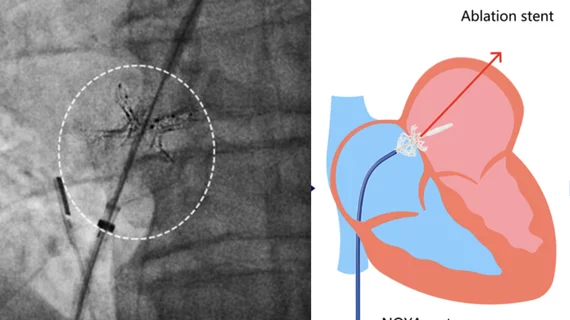
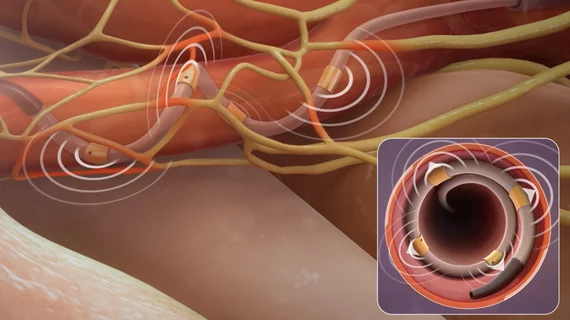
Researchers are using an intra-atrial shunt to lower pressures between the upper chambers of the heart to relieve symptoms in HFpEF heart failure patients. The novel Noya device uses an RF ablation to cut a hole into the septum and then enlarge it using a stent that can then be removed from the body after the procedure. 

Researchers are using an intra-atrial shunt to lower pressures between the upper chambers of the heart to relieve symptoms in HFpEF patients. The novel Noya device uses an RF ablation to cut a hole into the septum and then enlarge it using a stent that can then be removed from the body after the procedure.  Images courtesy of Sun et al. and Circulation: Heart Failure.

The first-in-man study, completed by a team of cardiologists in China, included 10 patients presenting with HFpEF. 

VIDEO: Use of mRNA drug to lower lipoprotein(a) by up to 98%

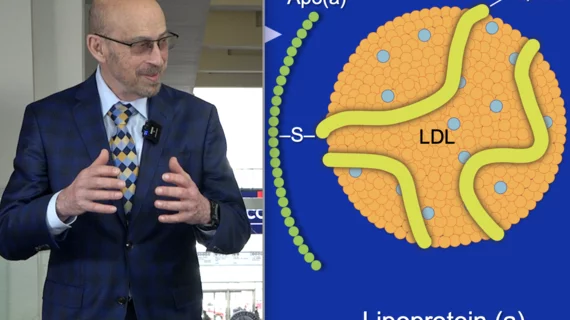
Steven Nissen, MD, Cleveland Clinic, explains an ACC.22 late-breaking trials that uses an mRNA drug to greatly reduce lipoprotein A. #ACC22

Steven Nissen, MD, of the Cleveland Clinic, explains an ACC.22 late-breaking trial that looked at if an mRNA drug could greatly reduce lipoprotein(a).

Steven E. Nissen, MD, chief academic officer of the Sydell and Arnold Miller Family Heart, Vascular and Thoracic Institute at the Cleveland Clinic, was the lead author on the Apollo Trial, a late-breaking ACC.22 study evaluating the effectiveness of an mRNA drug to suppress lipoprotein(a).